Blog
Learn what a managed service provider (MSP) is, how it works, pricing, benefits, types, and expert tips to choose the right MSP for your business in 2026.Jul 23, 2026
Table of Contents
- Introduction
- What is a Managed Service Provider
- What are the Benefits of working with an MSP
- What services do MSPs offer
- Engagement and Pricing Models Offered By MSPs
- Common Challenges of Working with MSPs
- Key Criteria To Choose The Best MSP
- Conclusion
Ever found out about your server crash only because the customer called to complain? Then you’ve already lived the problem managed service providers solve with proactive IT.
Instead of waiting for something to break and disrupting the business while it gets fixed (which typically took longer because of the reactive nature of problem solving), managed service providers identify problems before they interrupt critical business workflows, fix them as part of their scheduled maintenance strategy, and offer business continuity by keeping systems, network configurations, and security updates up and running.
That’s the case for a managed services provider in 2026. For decades, most businesses treated IT the way they treated plumbing: you call someone when something breaks, you pay by the hour, and you hope it doesn't happen again soon. That reactive "break/fix" model worked reasonably well when technology was simple. It doesn't work anymore.
Today, a single ransomware attack can shut down a mid-sized company for weeks. A missed software patch can expose sensitive customer data. A cloud migration done without expertise can spiral into a six-figure mistake. The stakes of "figuring out IT as you go" have gotten too high for most organizations to carry alone, and that's exactly why the managed service provider industry has grown into a market worth $437.3 billion in 2026, en route to $847.4 billion by 2033 according to a report by Grand View Research.
This blog helps SMB decision makers understand what managed service providers are, the benefits of engaging with them, the business problems they cater to, their engagement models, and the essential criteria a managed service company should have to be categorized as a true business partner.
What is a Managed Service Provider (MSP)?
A managed service provider is a third-party company you outsource to manage your business’s IT infrastructure and end-user systems on an ongoing, contracted basis, typically under a service-level agreement (SLA) that defines response times, coverage hours, and performance standards.
That’s the MSP definition on paper. In practice, a managed services company functions as an extension of your internal team, a supplemental IT department whose expertise you benefit from, without having to hire, train, and retain a full-time in-house team. From networking, security, disaster recovery, compliance, cloud infrastructure, and AI road mapping and implementation, a managed services partner owns the end-to-end technology strategy and execution in alignment with your business outcomes. As managed business continuity service providers, they enable you to focus on your core capabilities without IT bottlenecks coming in the way of business growth.
How Can SMBs Engage with Managed Service Providers?
As your outsourced technology partner, MSPs offer their round-the-clock expertise and services through a predictable fee or plan tailored to your business needs.
Most MSPs charge in one of a few ways:
- Per-user or per-device pricing is common for SMBs with straightforward setups, such as a 20-person accounting firm might pay a flat monthly rate per employee covering helpdesk, security, and device management.
- Tiered bundles let a growing retailer choose a basic plan for monitoring and backups, then add additional services as needs evolve- like partnering with a managed cloud service provider for e-commerce scalability once online sales start driving a bigger share of revenue.
- Some MSPs offer all-inclusive flat-rate plans, ideal for a law firm that wants unlimited support without worrying about per-incident costs.
- Others use a project-based pricing for one-off needs, like migrating a manufacturer's servers to the cloud.
Whatever the model, the business value they bring through transparent pricing is the same- supplementing IT expertise in necessary areas of SMB growth, ensuring that the absence of a dedicated in-house IT team does not come in the way of growth, revenue, and scale.
Think of it like payroll processing. Most companies don't build an in-house payroll department from scratch; they pay a specialist firm that already has the systems, expertise, and compliance knowledge to do it correctly and efficiently. MSPs apply the same logic to information technology.
What are the Benefits of Hiring A Managed Service Provider?
Having a dedicated technology service provider who that aligns all IT investments with business needs offers the following benefits:
1. Technical Expertise
MSP teams bring certified technology experts specialized in cross-industry technical expertise that's difficult and expensive to replicate in-house, including network architecture, cybersecurity, cloud migrations, AI governance, and the regulatory depth of a managed IT compliance service provider for standards like HIPAA, PCI-DSS, and CMMC. Their engineers are typically from the top 1% experts available in the respective domain, and they invest in their constant training and development to ensure that they are ahead of all technological advances. In practice, their experience is shaped by the real SMB environments they work in.
2. Enhanced Focus on Core Capabilities
Managed service providers take complete ownership of your technology direction and complexities, ensuring that IT becomes the core growth and revenue engine it really is, instead of a roadblock that prevents you from pursuing your core capabilities and priorities towards other growth pillars- be it team productivity, customer service, financial planning, and so on.
3. Ensured Technology Investment ROI
We’ve seen several SMBs struggle to get returns from their technology investments as their cloud subscriptions, M-365, and Power BI seats lie idle and forgotten till Finance teams pull out the monthly and quarterly costs. This underutilization of technology investments usually stacks up disadvantages in terms of escalating costs with no value, competitive strength, and overall business performance. An MSP prevents this by aligning your technology direction and investments with business outcomes, so each tool delivers measurable ROI and solves problems that hold your business back.
4. Cost Efficiency
A managed services provider for small businesses helps them access end-to-end IT, network management, cybersecurity, cloud services, IT compliance, and managed AI services under one roof, eliminating the limitations, time-taking procedures, and hefty cost investments for hiring individual experts in-house for each of these services. Additionally, MSP teams are seasoned in the nuances of these services from their exposure to real SMB complexities across industries. This kind of expertise takes years of investment and constant training to build in an internal team.
5. Competitive Edge
With top 1% expert teams trained extensively and bringing rich experience in aligning technology with real SMB needs, routine ticket volume, helpdesk requests, after-hours monitoring, and overall technology direction owned by a dedicated expert team, you are better positioned to compete, respond to evolving customer demands while it still makes a difference, and innovate to your complete potential.
6. Scalability
Whether you are adding ten new employees, expanding to a new location, or handling a seasonal sales spike that visibly adds to your revenue, proactive technology management from an outsourced partner can eliminate the complexity of scale and ensure system resilience from the ground-up, so expensive re-architecting and re-engineering aren’t always required when your capacity grows. Additionally, managed services providers keep your systems up and running, whether it is for 10 users or 100, ensuring that growing user volume doesn’t come with growing ticket volume and compromised user experience.
What Services Do Managed Service Providers Offer?
If you’re wondering what does a managed service provider do, this section will help you understand the services they provide in your business context:
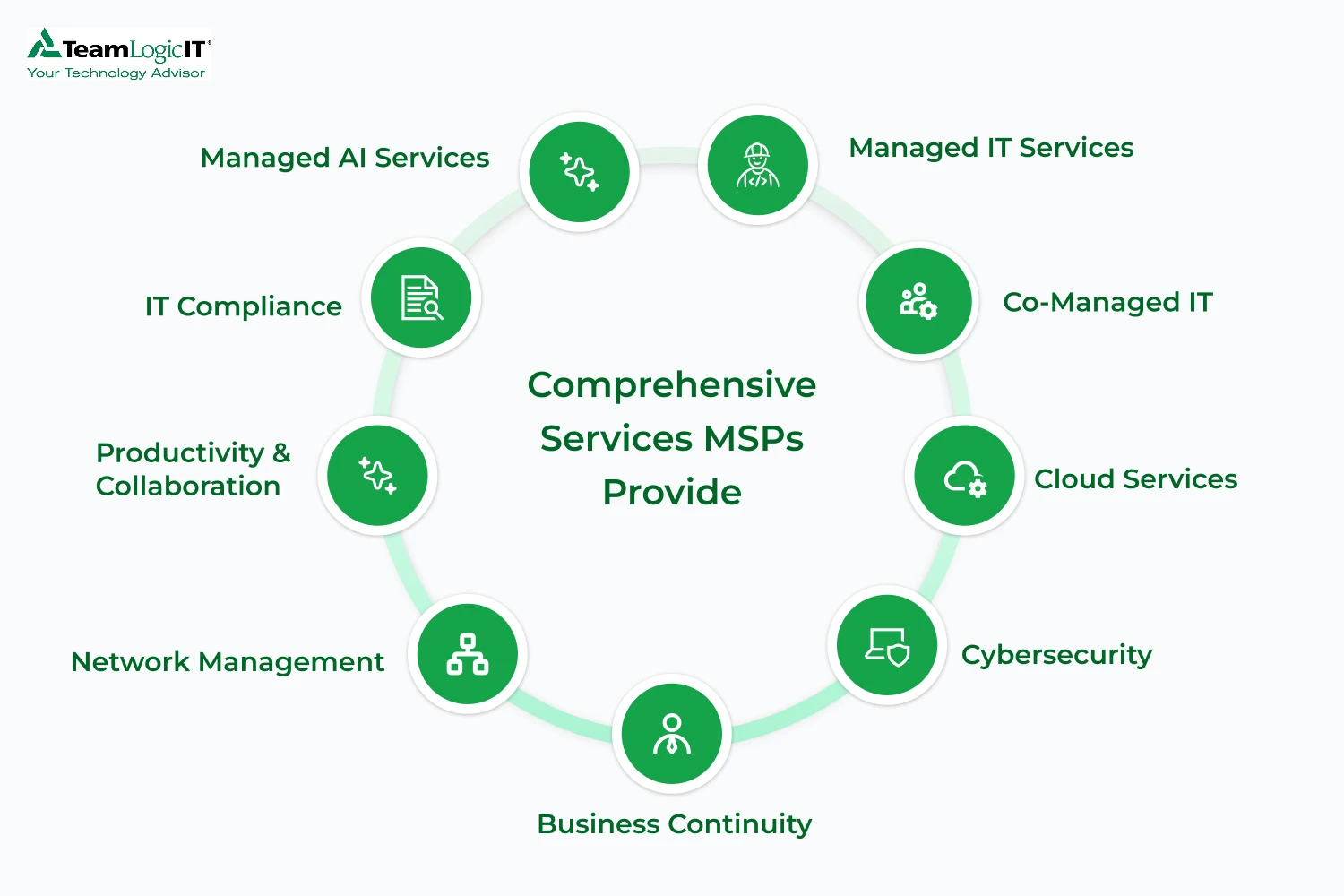
1. Managed IT Services
Business technology solutions in 2026 are more than a line item. They’re business performance drivers that empower your teams to deliver better, systems to run without interruption, and decisions to be made on data you can trust. As such, they require specific dedicated attention from technological experts who ensure that these performance drivers are always up-to-date to support your growing needs, without your internal teams having to spend more time on troubleshooting than running the business.
Managed IT services proactively support every device, server, and end-point, so your teams never have to worry about stalled operations because of prolonged downtime.
2. Co-Managed IT
The technology roadmap and strategy for a high-growth SMB can outpace the capacity of an internal IT team easily because of the sheer breadth of expertise required, fast pace of changes in a dynamic market, and the high velocity at which compliance needs and cyber threats evolve.
While an internal IT team may lack specialized expertise in one area, or simply be stretched thin with their focus on day-to-day tasks, co-managed IT services fill this gap to enable SMBs to understand what each change means for their business, blend the in-house team’s strengths with specialized expertise, and offer 24/7 support and monitoring with dedicated resources, so growth complexities never become a bottleneck.
3. Cloud Services
As SMBs grow, teams need to work across locations and devices without compromising security or control. Without expert oversight, flexibility can quietly introduce security gaps, unpredictable costs, and unreliable performance.
A managed cloud service provider offers a secure foundation across public, private, and hybrid environments, so the benefits of cloud services can be tailored to business outcomes, tool subscriptions can justify their investment, and cloud migrations can happen parallelly without disrupting critical workflows.
4. Cybersecurity
Cyber threats target SMBs daily, much to the surprise of many SMB decision makers who think their business size makes them immune to cyber-attacks. Without layered, adapting defenses, a single gap in protection can turn into a costly breach that can compromise revenue, trust, and credibility at once.
Managed service providers offer cybersecurity services to close that gap with protection tailored to your actual risk profile and combined managed Detection and Response with end-user and workstation protection, so bad actors (of which there is high proliferation in the age of AI) never catch the business off guard.
5. Business Continuity
Server outages, natural calamities, and every other event capable of halting operations mostly never comes with a warning. Without a plan for downtime, the frequency of stalled operations can affect productivity, revenue, and customer trust. We’ve had SMBs come to us with complete system outage when a critical meeting was due, leading even the CEO to lose access.
Business continuity services take a proactive approach to downtime minimization and disaster recovery, combine active monitoring with dedicated backup, and ensure multi-layered security and quick data recovery act as pillars of built-in resilience.
6. Network Management
A business's network drives every decision and operation behind the scenes, but without constant oversight, small vulnerabilities can undermine performance and security. Slow systems and undetected threats erode productivity long before they become visible problems.
Network Management delivers 24/7 proactive monitoring, next-gen firewalls, and intrusion detection to maximize uptime and defend against threats. Real-time visibility and scalable performance keep the network ready for today and tomorrow, so reliability is a given in all circumstances.
7. Productivity and Collaboration
Remote work means greater flexibility for distributed teams, but not without the right systems in place to unify tools and workflows across different servers, devices, and time zones for effective collaboration. Most remote and hybrid teams struggle with navigating the friction of remote work, when they should work without any distraction.
MSP productivity and collaboration services set up secure cloud workspaces, integrated communication, and workflow automation tailored to how the team actually works. Their experts offer customized setup and onboarding resources to eliminate remote collaboration friction and help SMBs perform to their fullest potential, anywhere, anytime!
8. IT Compliance
Regulatory standards like HIPAA, PCI-DSS, CMMC, and SOX are evolving constantly, and a single overlooked gap in aligning all systems and policies can lead to costly penalties or reputational damage.
IT Compliance services offer structured governance, risk, and security frameworks that uncover gaps and mitigate risk before regulatory penalties strike. By aligning systems and processes with the latest standards, compliance becomes a strategic advantage through a controlled function that caters to regulatory needs all year-round.
9. Managed AI Services
SMBs want to adopt AI, but without the right readiness, governance, or oversight, that adoption can introduce more risk than return. We’ve had several SMB owners come to us with stalled AI pilots, lack of clarity on what problem they need AI to solve, and how to get AI to work for their business. That’s why use case clarity, data governance, and business value alignment is necessary for SMBs to have their AI investments deliver.
Managed AI Services provide readiness assessments, data governance, and continuous monitoring to align AI adoption with business goals. With expert guidance behind every step, AI adoption stays secure, compliant, and genuinely productive, so your business is ready to maximize the potential of AI for teams, better decisions, and cost control.
Engagement and Pricing Models Offered By Managed Service Providers
MSP pricing has moved almost entirely away from hourly billing toward subscription-style models. Here's how the most common structures work:
- Per-Device Pricing charges a flat fee for each device under management (servers, workstations, network equipment). This works well for businesses with predictable device counts but can get complicated with a mix of device types.
- Per-User Pricing charges a flat fee per employee, regardless of how many devices they use. This has become popular as employees increasingly use multiple devices (laptop, phone, tablet) for work.
- All-Inclusive/Flat-Fee Pricing (sometimes called the "all-you-can-eat" model) bundles all agreed-upon services into one flat monthly rate, offering maximum budget predictability.
- Tiered/Bundled Pricing offers multiple service packages (e.g., Essential, Standard, Premium) at different price points, letting businesses choose the bundle that fits their needs and budget.
- Monitoring-Only Pricing covers just alerting and monitoring, without broader management or support, typically the lowest-cost option, best suited to businesses with some existing internal IT capability.
- Value-Based/Outcome-Based Pricing ties fees to specific business outcomes (uptime percentage, ticket resolution speed) rather than a flat unit count, less common, but growing as MSPs mature their service delivery metrics.
- A La Carte/Hybrid Pricing combines a base monitoring fee with billable rates for specific project work or after-hours emergencies, a middle ground between full break/fix and full flat-fee coverage.
Which Pricing Model Fits Your Business?
Pricing Model | Ideal For (Business Need) | When To Choose |
Per-Device Pricing | Businesses with a stable, predictable device count (servers, workstations, network equipment) | Choose when device count is consistent and device-based cost tracking matters more than headcount. |
Per-User Pricing | Businesses where employees use multiple devices (laptop, phone, tablet) | Choose when your workforce is mobile or device-heavy per employee, and per-employee cost predictability matters most. |
All-Inclusive/Flat-Fee Pricing | Businesses that want maximum budget predictability without tracking incidents | Choose when you want unlimited support coverage and zero surprise costs, regardless of ticket volume. |
Tiered/Bundled Pricing | Growing businesses whose needs will expand over time | Choose when you want to start with essential coverage and add services (like cloud or security) as the business scales. |
Monitoring-Only Pricing | Businesses with some existing internal IT capability | Choose when you already have in-house support and just need alerting/monitoring as a safety net. |
Value-Based/Outcome-Based Pricing | Businesses focused on measurable performance metrics | Choose when uptime percentage or ticket resolution speed matter more to you than a flat unit count. |
| Businesses with occasional project needs alongside baseline monitoring | Choose when you need a balance of ongoing monitoring and flexibility for one-off projects or emergencies. |

What are the Common Challenges of Working with Managed Services Providers?
Described below are common challenges of working with an MSP company:
1. Vendor Lock-In
Vendor lock-in happens when it’s difficult to change your provider even when you’re not satisfied with their offerings. Discontinuing the relationship with some MSPs can either cost more than the investment, leave you in the dark if only they understand how your data, systems, and licenses are used, and compromise control if processes were poorly documented.
Risks:
- Rebuilding from scratch
- Prolonged downtime for gaining control of your own systems
- Steep exit fees
2. Response Time Gaps
Some MSPs stretch thin across too many clients or rely on tiered support queues, leaving your urgent issue waiting behind others while your team sits idle, and revenue-impacting problems go unresolved. That’s how a response time gap prolongs the resolution you were promised instantly but receive long after something breaks.
Risks:
- Extended downtime during critical outages
- Missed SLAs with no accountability
- Compromised customer trust and credibility
3. Security as an afterthought
Not every provider treats cybersecurity as a core competency; some genuinely specialize in infrastructure and treat security as a thin add-on. Others prioritize security from the ground up, embedding it into every layer of their service instead of bolting it on after the fact. The former category of MSPs brings the risk of identifying security lapses when major breaches have triggered penalties.
Risks:
- Undetected vulnerabilities left unaddressed
- Compliance gaps that surface only during an audit or breach
- Costly incident response after damage is already done
4. Cultural Misalignment
Some MSP companies fail to bridge the gap between technology and business outcomes, while others function as a true extension of your team by ensuring there are no gaps in understanding how technological investments are delivering business outcomes. If you’re working with the former kind, there are high chances that you have no visibility into where your investments are headed.
Risks:
- Technology decisions made without business context
- No clear line between IT spend and business results
- Growing disconnect between your team and your provider over time
Key Criteria to Choose the Best Managed Service Provider
While collaborating with an MSP is necessary for business growth, the engagement model itself is not risk-free, if not for the right partner. The best managed service provider will never let the above challenges come in the way of the relationship. Based on the evaluation criteria discussed below, you can identify the right outsourced technology partner for your business:
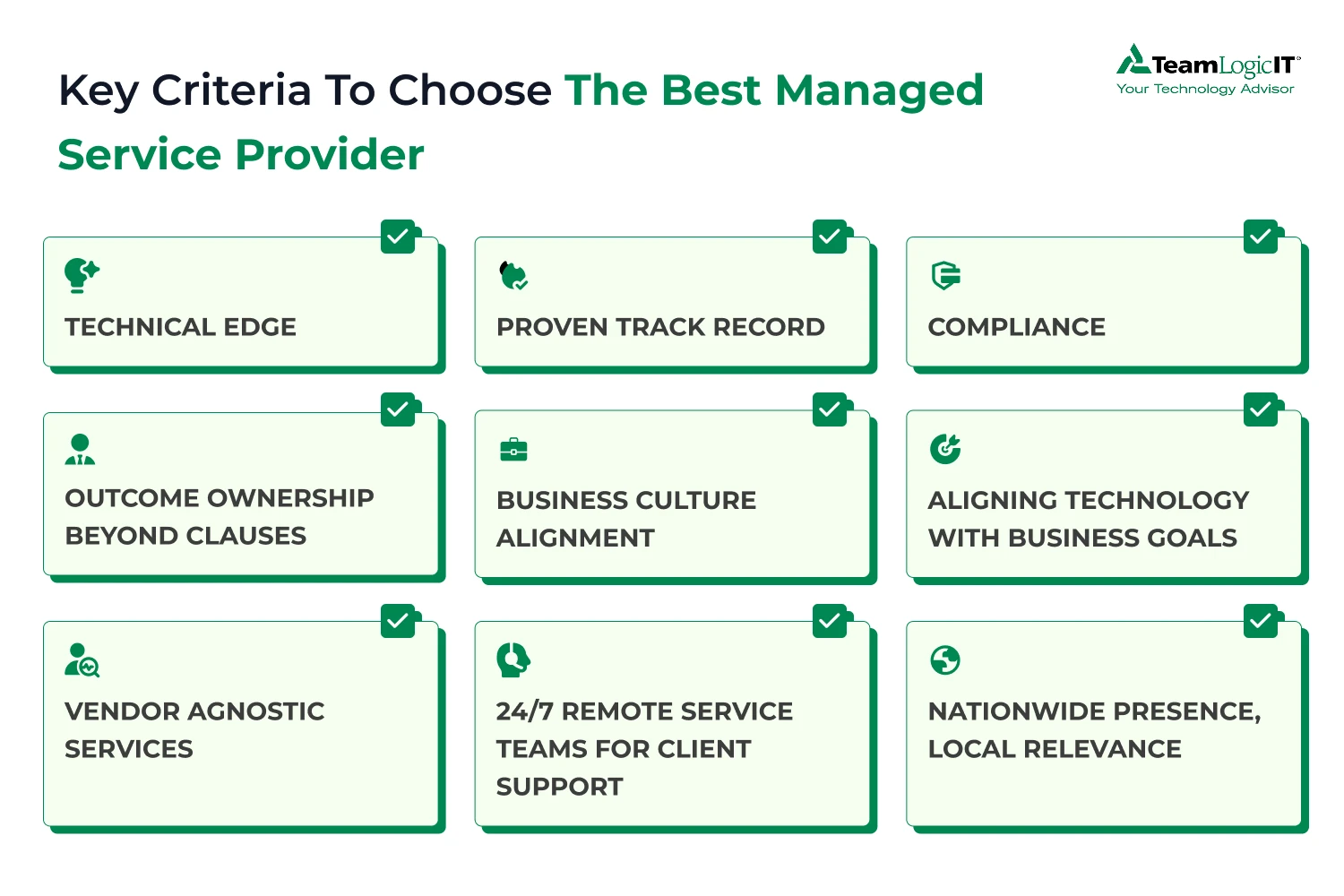
1. Outcome Ownership Beyond Clauses
A trusted MSP like TeamLogic IT won’t just bind you in clauses. Our seasoned team offers a true partnership where we own your business problems and map our technology solutions to exact business outcomes. If something doesn’t move your defined business goals forward, it doesn’t make it to the contract or bill.
2. Business Culture Alignment
We don’t work in isolation. We function as an extension of your team through a dedicated account manager and a VP/GM for your region. Account managers translate business goals into technical priorities, own the service quality, and align technical teams based on your project goals in a manner that you get daily and weekly updates of progress, and VP/GMs remain invested in personalized support, and proactive service improvement to ensure your teams get maximum ROI from this partnership- including revenue growth, empowered teams, and improved business performance.
3. Aligning Technology with Business Goals
No technical investment is good enough for your business if it doesn’t help your organization solve long-standing problems, show measurable results, and drive a transformation from inefficiency to efficiency. We understand your business goals, present limitations, and define our project scope around exactly what works for your business. That’s our operational standard yardstick.
4. Technical Edge
It goes without saying that your business gains access to certified technology experts- be it for M365, Azure, GCP, or AI. Our teams constitute the top 1% talent nation-wide from their domain and bring over decades of experience in making bleeding-edge tech work for SMB environments across industries. Where we draw the defining line of difference with our technical edge is our practice of using every tech stack internally to drive our own business outcomes forward before it makes it to our client offerings.
If we promise you that we can make AI save you critical business time, it’s because we have done it ourselves by reducing the time spent on annual client analysis from 100+ hours to just 12 hours per year.
5. Nationwide Presence, Local Relevance
It is very natural for you to look for a “managed service provider near me”, so geographical distance doesn't come in the way of business necessities. TeamLogic IT offers nation-wide services across 350+ locations in the USA. We are nationally trusted and bring local relevance to each region, with our extensive network of 1000+ engineers only two hours away from your location.
6. Compliance
Compliance isn’t an isolated annual task for us. It’s a continuous, proactive, and prioritized function for us. Whether it is SOC 2 Type II, CMMC, HIPAA, or GDPR, we offer a tailored approach to help your business meet these requirements on paper and in practice, with year-long vigilance offering visibility into where sensitive data resides and protecting it with robust mechanisms without an audit catching you off-guard.
7. Vendor Agnostic Services
Our services are vendor-agnostic and tailored to your business needs. Our team consists of experts across all major technology stacks used in an operational SMB environment, so we’ll never make a recommendation because it matches our expertise. Our recommendation will be based on what your business truly needs, respecting your existing tech stack, time, team investment, and budget.
8. 24/7 Remote Service Teams for Client Support
The success of an outsourced technology partner depends on how seamlessly they can collaborate with you and drive business goals forward. Beyond ticket resolution, we have an extensive remote services team available 24/7 to respond to your calls within 5 minutes and solve the issue at hand. Your urgency is our urgency, and we have experts available round the clock to help you move forward from the roadblock at hand.
9. Proven Track Record
A seasoned MSP like us draws on years of experience to deliver technology solutions for business outcomes. Our partnership brings you that rich exposure across industries and the prior knowledge of pitfalls to avoid from our proven track record across industries- as our client testimonials attest. We’ve been there, done that, so you don’t have to figure IT out while your business suffers.
Conclusion
The break/fix model that businesses relied on for decades was never built for the stakes SMBs face today, whether that's a ransomware attack, a missed compliance deadline, or a cloud migration gone wrong. Managed service providers exist to close that gap, not just by fixing what breaks, but by preventing it from breaking in the first place, aligning every technology investment with the business outcomes that actually matter.
The real difference lies in the partner you choose. An MSP that treats security, compliance, and business alignment as core to their service, not an afterthought, is the one that turns IT from a cost center into a growth engine. That's the standard TeamLogic IT holds itself to: outcome ownership, technical depth, and a partnership that shows up long before something goes wrong. It’s your business you trust us with. Making technology work for your business is our business, our way of life. That’s why we exist.